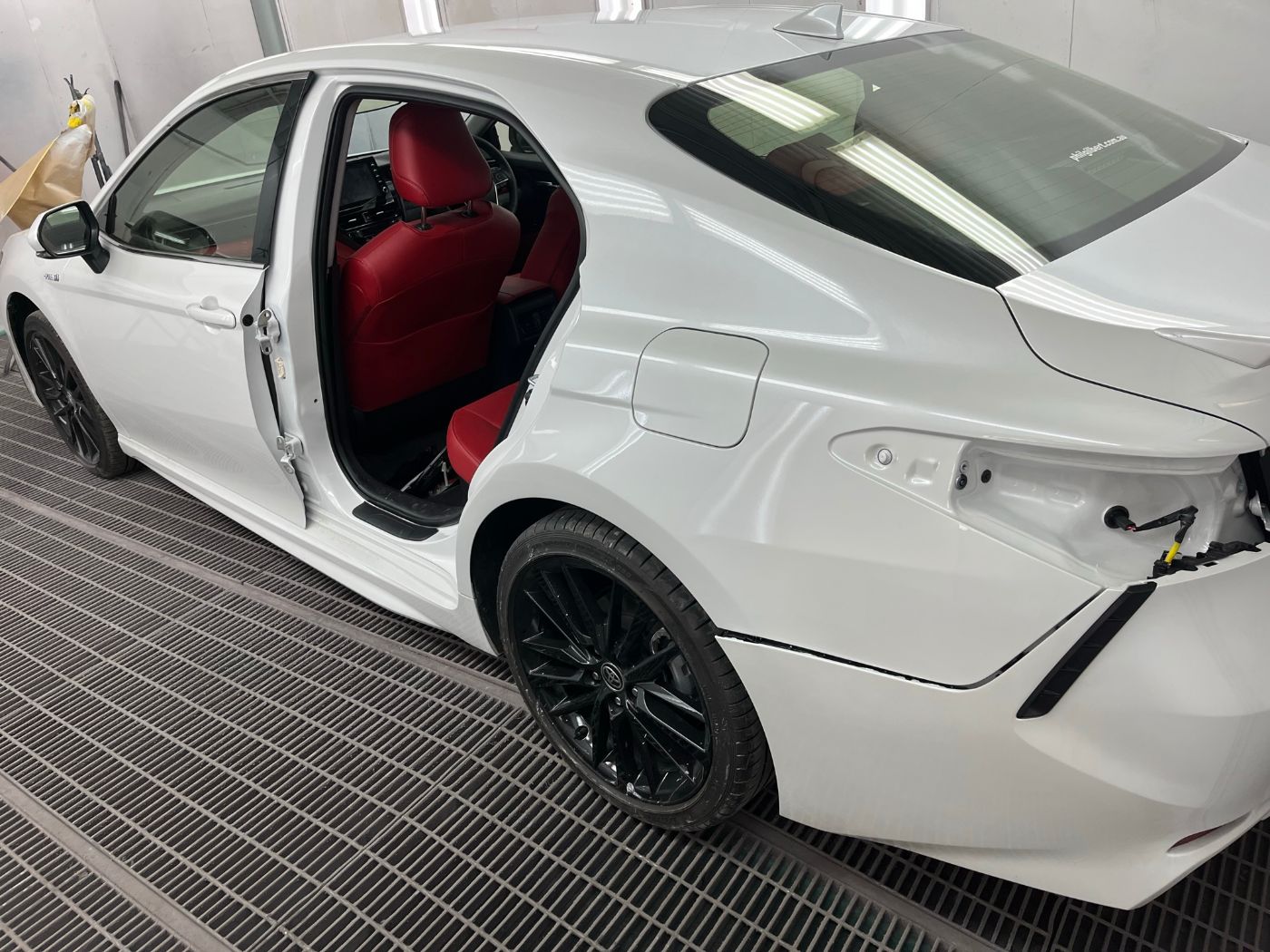
A repaired panel matches the rest of your car because the paint is mixed to your car’s own factory code, checked against the paint that is actually on the car today, and then sprayed so it fades out into the panels beside it instead of stopping at a hard edge. That blend is why paint work usually takes longer than the panel work before it.
Your paint code is the starting point, not the answer
Every car leaves the factory with a paint code, on a build label or compliance plate. Where that label sits depends on the make: a door jamb, under the bonnet, or inside the boot. The code gives the formula for your colour as it was mixed when the car was new.
Two things stop that being the whole story. One code often has several factory variants, because paint mixed at different plants and batches does not land in precisely the same place. And then there is sunlight: a car parked outside through a few Sydney summers has paint that has shifted, reds and some whites most of all. Match the code alone and you get one panel looking newer than everything around it. The job is to match the car in front of us, not the car as it left the showroom, which is why colour is settled before the gun comes out on any of our car spray painting in Parramatta.
How car paint colour matching actually works
- Find the code, then choose the variant. The label gives the code. Where that code has known variants, the right one is picked by comparing them against the paint on your car, not from the paperwork.
- Mix and spray a test card. The formula goes onto a card or spare panel using the same gun, coats and technique as the car itself, because all three change how the colour reads.
- Compare it in the right light. The card is held against a clean part of the car, straight on and from an angle, in daylight as well as workshop light. Colours that agree under one light can disagree under another.
- Tint if it needs it. Close but not right means adjusting the mix and testing again. This step separates a match you cannot find from one that nags at you
- Prepare and prime. The repair is sanded back, filled where needed, primed and sanded flat. Paint hides nothing: a ripple left in the panel is still there under a perfect colour.
- Mask, seal and lay the colour. Everything not being painted is masked, the panel is sealed, and the base coat goes on in coats, carried past the repair into the next panel.
- Clear, cure, polish, reassemble. Clear goes over the colour and the blend area, the paint cures in the booth, then the finish is polished and the car reassembled and checked.
Why your door gets painted when only the bumper was hit
If colour were a single fixed number, a painter could spray the damaged panel to its edge and stop. In practice even a very good match sits a shade away from the paint beside it, and a straight edge is where the eye looks. Fading the colour out into the next panel leaves no line to catch.
How far the blend goes depends on the colour and the shape of the car. Solid colours are kindest. Metallics and pearls are harder, because the flakes lie in whatever direction the gun put them, so one mix can read differently on a flat door and a curved quarter panel. Three-stage finishes, with a tinted layer over the base and under the clear, ask for the most blending of all. So paint on an undamaged panel in a quote is usually the blend, not padding, and it is part of why paint time rarely tracks the size of the dent — see how long smash repairs take.
Bumpers are a different job to panels
A bumper cover is plastic, not steel, and that changes the work under the colour. Plastic needs its own preparation and an adhesion promoter or flexible primer so the paint flexes with the bumper instead of cracking off at the first car park knock. It also reads colour a little differently to metal, so even from the factory a bumper can sit slightly away from the guard beside it, and the match is made to the panels either side.
Not every scrape needs paint. A shallow scuff in the clear coat can sometimes be cut and polished, and a dent with the paint unbroken is often a job for paintless dent removal, which we do in-house and which leaves the factory finish where it is. Once the paint is through, it becomes a bumper and scratch repair, and the colour work above applies.
| What you have | What it means for paint |
|---|---|
| Dent with the paint unbroken | Often paintless dent removal: no repaint at all |
| Scuff in the clear coat only | May cut and polish out without spraying |
| Scrape through to primer or bare panel | Prepare, prime, match and blend |
| Replacement panel or bumper | Arrives in primer, so it is painted to the car |
What you are entitled to expect from the finish
Paint quality is not purely a matter of taste. NSW Fair Trading’s guidance on vehicle repairs and maintenance says a repairer “has a responsibility to make sure that repair work is done in a ‘tradesman like manner’”, meaning repairs must be “of acceptable quality and carried out with due care and skill”. The ACCC puts the same obligation on services generally under the consumer guarantees: “Service providers must carry out all services using an acceptable level of care and skill.”
Get the warranty in writing. Fair Trading notes that “for a warranty to be enforceable, it must form part of the repair contract”, and suggests you “ask the repairer to write down the warranty conditions on the invoice”. Ours is a lifetime guarantee on workmanship for as long as you own the vehicle; paint and replacement parts are covered by their own manufacturer warranties. If the colour does not sit right once you see the car in daylight, say so rather than living with it — finished jobs are on our our work page.
Car spray painting FAQs
Will the new paint match the rest of my car exactly?
The aim is a match you cannot pick, and on most colours that is achievable: the right variant, a test card first, and a blend into the panels beside the repair. Faded paint and three-stage colours take more work to get there.
Can you paint just the damaged panel?
Sometimes, where a shut line or body feature gives the colour somewhere to stop. More often it needs carrying into the next panel and fading out. We will tell you which it is when we write the estimate.
Do I have to use the repairer my insurer nominates?
That depends on your policy. Fair Trading’s note on choice of repairer after an accident is that “insurers may require you to use a repairer from their network”, so check your policy wording or ask your insurer. We are a CGU preferred smash repairer and regularly repair for AAMI, Allianz, APIA, Budget Direct, GIO, NRMA, QBE, Suncorp, Youi and other insurers.
Will a respray affect my new car warranty?
Having the work done outside a dealership does not by itself void a new car warranty. We have written that up separately in will independent smash repairs void my new car warranty.
Want the paint work looked at before you decide?
Bring the car to 11 Bourke St, North Parramatta for a free estimate, or call us on (02) 9630 4699. Open Monday to Friday, 7am to 3pm, and Saturday 8am to 11am. Our smash repair FAQs cover what happens next.